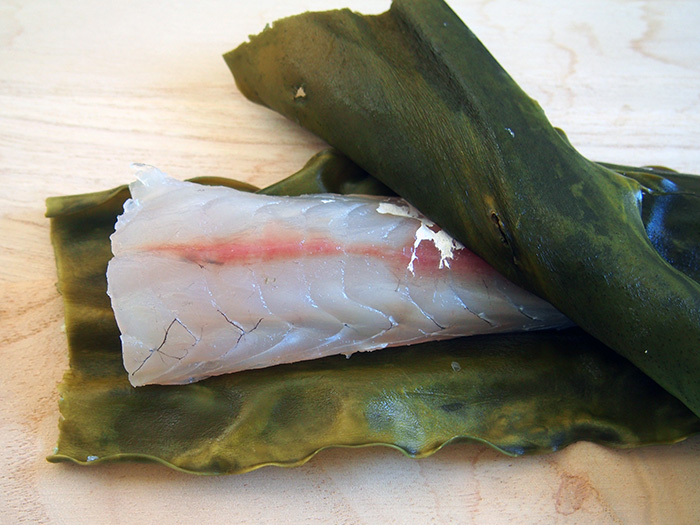
Kobujime is a method of aging sashimi, typically white-fleshed fish like sea bream, grouper, or flatfish, by wrapping it in kombu (kelp) for one to two days. Originally a traditional culinary method from Toyama Prefecture, it was developed as a way to preserve sashimi.
The process involves sprinkling salt over the fish, layering kombu on top, sealing it tightly, and refrigerating it for several hours to a few days. Kombu absorbs moisture from the fish, tightening its texture and preventing oxidation to maintain freshness. At the same time, the glutamic acid and other components in kombu infuse into the fish, creating a deeper flavor than fresh sashimi. A key point in kobujime is to use dried kombu without rinsing it in water. While dust or debris should be wiped off with a dry cloth, the white residue on the kombu contains flavor-enhancing components.
While many people say "konbujime," the correct Japanese pronunciation is "kobujime." The name combines "kombu" (kelp) and "shime" (tightening or preserving), with "shime" becoming "jime" due to Japanese phonetic changes, similar to the linking sounds in Korean. On menus in Japan, it is often written as "昆布〆" using the character for "shime" (〆).
The reason it is called "kobujime" instead of "konbujime" is multifaceted. When used in dish or menu names, "kombu" becomes "kobu," as seen in "kobucha" (kelp tea), "kobumaki" (kelp roll), and "kobujime." In the Kansai region, dishes using kombu are thought to sound more elegant when pronounced "kobu" rather than "konbu." Another theory suggests that sushi restaurants in Hokkaido adopted "kobujime" on their menus because it was easier to pronounce than "konbujime." Overall, pronunciation convenience seems to play a significant role.